2026 Best LED Panel Lights for Global Buyers?

Choosing the right led panel lights in 2026 requires more than comparing brightness and purchase prices. Global buyers now evaluate energy efficiency, visual comfort, installation conditions, and long-term support. A panel that performs well in a quiet office may disappoint in a humid warehouse or a retail store with high ceilings.

This guide examines practical options for different markets and project requirements. It considers light output, color rendering, flicker performance, glare control, dimming methods, and expected service life. It also reviews voltage compatibility, mounting systems, driver quality, warranty terms, and available certifications. These details can influence maintenance costs more than the product label suggests.

Real projects reveal the difference. A 600-by-600-millimeter panel may fit a suspended ceiling neatly, while an unsuitable driver can create visible flicker above workstations. A high-efficiency model may reduce electricity use, but its initial price could challenge a small renovation budget. Buyers should check local electrical requirements and confirm documentation with qualified suppliers.

No single model wins every project.

This comparison is based on manufacturer specifications, market evaluation, and practical purchasing concerns. However, specifications are not always tested under identical conditions. Some claims may also require independent verification. Therefore, the recommendations should support careful decisions, not replace site assessments or professional electrical advice. The best led panel lights balance reliable performance, safe installation, comfortable illumination, and realistic ownership costs across different regions.
2026 Best LED Panel Lights for Global Buyers?

LED Panel Light Basics: 2026 Efficacy Targets Above 120 lm/W

LED Panel Light Basics: 2026 Efficacy Targets Above 120 lm/W

For 2026 projects, global buyers should treat 120 lm/W as a system target. This figure should include the LED, driver, diffuser, and housing. Chip efficiency alone can create a misleading impression. A panel producing 6,000 lumens at 50 watts reaches 120 lm/W. In a real office, however, dust, heat, dimming, and installation losses reduce output.

Check the test report carefully. It should identify input wattage, delivered lumens, color temperature, CRI, and test conditions. A stable driver matters as much as the LED package. Flicker measurements also deserve attention, especially in offices with cameras or long working hours.

I prefer panels with CRI 80 or higher for general spaces, while retail and healthcare areas may need better color accuracy.

Thermal design is easy to overlook. Touching a poorly cooled panel after several hours can reveal uneven heat. That is not a complete test, but it raises a useful question. Ask for LM-80 and TM-21 data when available, plus a stated lifetime at a defined temperature. UGR below 19 may support office comfort, but room layout and ceiling height still change the result. A high-efficacy panel can disappoint if glare is excessive. Procurement teams should compare delivered light, warranty terms, replacement access, and regional electrical compatibility—not only the largest number on a specification sheet.

Key Performance Metrics: CRI 80+, UGR<19, and 50,000-Hour Life

2026 Best LED Panel Lights for Global Buyers?

For global buyers, CRI 80+ is a practical minimum for offices, classrooms, and retail spaces. It helps white paper, skin tones, and product colors appear more natural. The U.S. Department of Energy’s solid-state lighting reports emphasize measured color quality, efficacy, and long-term reliability. However, CRI alone can hide weak red rendering. A panel with CRI 80 may still look slightly flat. Check R9 and TM-30 results when available.

UGR below 19 supports comfortable office lighting under common European workplace guidance. The CIE 117 method calculates glare from luminance, room geometry, and observer position. A diffuser alone cannot guarantee low glare. Installation height and ceiling reflectance matter. For service planning, a 50,000-hour life rating is useful, but it needs context. IES LM-80 measures LED lumen maintenance, while TM-21 projects future performance. It does not promise zero failures for every driver or panel.

Tips: Request LM-80 and TM-21 evidence, not only a marketing claim. Confirm CRI, R9, UGR test conditions, flicker results, and driver replacement options. The European Commission’s lighting product studies also stress that real energy performance depends on controls and operating hours. Dimming can help, but poor compatibility may create noise or flicker. Test one installed sample before ordering thousands. Small mistakes become expensive.

Panel Types and Applications: Edge-Lit, Back-Lit, and Modular Designs

2026 Best LED Panel Lights for Global Buyers?

Panel Types and Applications: Edge-Lit, Back-Lit, and Modular Designs

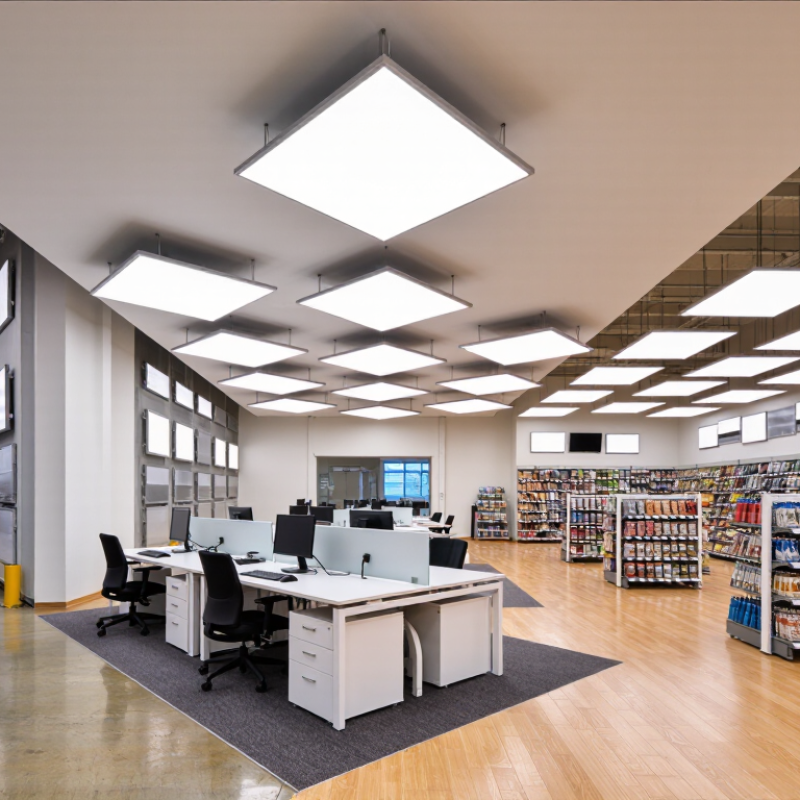
LED panels are no longer a single ceiling product. Edge-lit panels use side-mounted diodes and a light guide, creating slim bodies for offices, corridors, and shallow ceilings. Their design saves installation space, but poor diffusion can produce bright edges or uneven corners. Back-lit panels place LEDs behind the diffuser. They usually offer stronger uniformity and easier heat management, making them suitable for classrooms, hospitals, warehouses, and higher ceilings. The choice is practical, not fashionable. A 40-watt panel using 4,000 lumens may outperform an older fluorescent fixture, but only if glare remains controlled. The U.S. Department of Energy reports that LEDs can use up to 75% less energy and last up to 25 times longer than incandescent lighting.

Modular panels support replaceable drivers, scalable layouts, and custom dimensions. They work well in retail grids, clean workspaces, and projects with changing floor plans. However, more modules can mean more connection points and maintenance checks. I would not judge efficiency from wattage alone. Review delivered lumens, efficacy, UGR, color consistency, emergency compatibility, and thermal test evidence. DOE solid-state lighting guidance recommends checking photometric performance and long-term LED data, including LM-79 and LM-80 documentation.

Tips: Measure ceiling depth before choosing edge-lit products. Request a real photometric file, not only a catalogue image. Test one sample beside existing lighting. Small trials reveal glare, shadows, and unpleasant color shifts. Reflective ceilings can also change the result.

Global Compliance Guide: CE, RoHS, UL, DLC, and IEC 60598 Standards

For global buyers, the best LED panel light is not defined by brightness alone. Compliance documents must match the exact model, driver, voltage, and production version. In European markets, CE indicates the manufacturer’s declaration of conformity with applicable requirements. RoHS addresses restricted substances in electrical products. Neither document, by itself, proves complete product quality. Ask for the signed declaration, technical file references, and current test reports.

IEC 60598 provides important safety requirements for luminaires, including insulation, temperature, wiring, and mechanical protection. For North American projects, UL-related evaluation can support electrical safety acceptance, while DLC qualification may help meet commercial efficiency programs. DLC is not a universal legal requirement. It also depends on product performance data, such as efficacy, lifetime, and tested configurations. Check whether the listed model matches the delivered panel, not just a similar housing. Small details matter: a 600 × 600 mm panel, 4000K color temperature, and 0–10V dimming should appear consistently across labels, reports, and quotations. I have seen attractive files with outdated model numbers. That should trigger a pause. Request photometric files, warranty terms, sample inspection records, and factory quality-control evidence. Even experienced buyers can overlook regional differences in emergency lighting, fire ratings, or installation requirements. Local approval may still be necessary.

2026 Best LED Panel Lights for Global Buyers? - Global Compliance Guide: CE, RoHS, UL, DLC, and IEC 60598 Standards

Compliance Area Primary Market Legal or Commercial Status Main Scope for LED Panel Lights Typical Technical Evidence Buyer Verification Points
CE Marking European Union and European Economic Area markets Generally mandatory when the product falls within applicable EU harmonisation legislation Electrical safety, electromagnetic compatibility, and other applicable product requirements EU Declaration of Conformity, technical file, risk assessment, test reports, product label, and user instructions Confirm that the Declaration of Conformity identifies the correct model, applicable directives or regulations, relevant standards, manufacturer, and authorised signatory
Low Voltage Directive
(2014/35/EU)
European Union and European Economic Area markets Mandatory for covered electrical equipment operating within the directive voltage ranges Protection against electric shock, fire, excessive temperature, insulation failure, and mechanical or thermal hazards Safety test report, insulation and dielectric-strength results, earth-continuity results where applicable, temperature-rise data, and construction review Check rated input voltage, driver safety data, protective-earth or double-insulation design, wiring terminals, and enclosure temperature
EMC Directive
(2014/30/EU)
European Union and European Economic Area markets Mandatory for covered electronic lighting equipment Radiated and conducted emissions, immunity to electromagnetic disturbances, and stable operation in the intended environment EMC laboratory report covering emissions and immunity tests using applicable lighting-equipment standards Verify that the report covers the complete luminaire, including the LED driver, dimming interface, sensor, and emergency-control accessories if supplied
RoHS Directive
(2011/65/EU and amendments)
European Union and many markets that reference EU substance restrictions Mandatory for electrical and electronic equipment within scope Restriction of hazardous substances in homogeneous materials used in the panel, driver, cable, connector, housing, and accessories Supplier declarations, material declarations, component records, and laboratory screening or chemical analysis where required Check the latest restricted-substance list and maximum concentration values; standard limits include 0.1% for most listed substances and 0.01% for cadmium by homogeneous material
UL Safety Certification United States; related North American requirements may apply in Canada Usually a market-access, specification, insurance, or authority requirement rather than a universal federal requirement for every installation Construction, electrical safety, fire risk, driver suitability, installation method, and end-use conditions for luminaires Certification record, product marking, installation instructions, component approvals, and applicable safety testing, commonly involving UL 1598 and LED-related requirements such as UL 8750 Verify the exact model and configuration in the certification database; confirm voltage, mounting type, damp-location rating, emergency option, and field-modification limitations
DLC Qualification North American commercial and institutional lighting projects Voluntary energy-efficiency qualification; often required by utility rebate programs or project specifications Performance and controllability of commercial LED luminaires, including efficacy, light distribution, quality, and product information Independent photometric testing, electrical performance data, lumen-maintenance information, product specification sheets, and listing under the current technical requirements Check the current qualified-products list, exact model number, wattage, correlated colour temperature, control option, and rebate eligibility before purchase
IEC 60598-1 International reference; adopted or adapted by many national and regional standards systems A technical safety standard; legal status depends on the destination market and its adopted national version General requirements and tests for luminaires, including marking, construction, wiring, protection against electric shock, insulation, heating, creepage, clearance, and mechanical strength Test report referencing the applicable edition and national deviations, with samples matching the production configuration Confirm the edition, national adoption, input conditions, LED-driver combination, mounting method, and whether the report covers the complete panel luminaire
IEC 60598-2-2 International markets for recessed luminaires Product-type standard used together with IEC 60598-1; local authorities determine enforceability Additional requirements for recessed luminaires, including installation clearances, mounting arrangements, heat management, and accessibility of live parts Combined test report to IEC 60598-1 and IEC 60598-2-2, supported by installation instructions and thermal test results Confirm whether the panel is recessed, surface-mounted, suspended, or modular; ensure the report matches the actual ceiling system and mounting accessories
Photometric and Lifetime Data Global procurement and project evaluation Usually a technical and commercial requirement; exact requirements depend on the project Light output, efficacy, colour consistency, glare, colour rendering, power factor, total harmonic distortion, and expected lumen maintenance Accredited laboratory photometric report, integrating-sphere or goniophotometer data, electrical measurements, and LED lumen-maintenance projections Compare delivered lumens rather than LED chip lumens; request UGR data where relevant, test ambient temperature, colour tolerance, warranty conditions, and replacement-part availability
Procurement note: Compliance obligations vary by destination, installation method, voltage, control system, emergency function, and project specification. Buyers should verify the current edition of each applicable standard and request documents for the exact LED panel light model and configuration.

Buyer Comparison Framework: Wattage, CCT, Warranty, and Total Cost of Ownership

2026 Best LED Panel Lights for Global Buyers?

A reliable comparison starts with the room, not the product label. Measure ceiling height, desk area, and existing illumination before choosing wattage. A 36-watt panel may suit a small office, while a 48-watt model can reduce dark corners in larger rooms. Higher wattage is not automatically better. Excess brightness can create glare, heat, and wasted energy. I have seen buyers choose by wattage alone, then replace panels after uncomfortable reflections appeared.

CCT affects how people experience a space. Around 3000K feels warmer and suits hospitality areas. Around 4000K often supports offices, classrooms, and retail displays. Around 5000K looks sharper, but it may feel harsh during long work sessions. Check the manufacturer’s CCT tolerance and color-rendering data, not only the advertised number. Small variations matter near white walls. I still consider CCT preference partly subjective.

Warranty comparison requires careful reading. Check coverage length, driver protection, labor terms, and replacement procedures. A five-year warranty has limited value if shipping costs remain unclear. Confirm input voltage, operating temperature, dimming compatibility, and certification requirements for the destination market. These details can prevent installation delays.

Total cost of ownership includes purchase price, installation, electricity, maintenance, and disposal. Estimate annual energy use with this formula: watts × operating hours × electricity rate. A slightly higher-priced panel may consume less power and maintain brightness longer. However, efficiency claims need independent test evidence. I have trusted attractive figures too quickly before. Real performance can differ after dust, heat, and frequent switching. Keep invoices, test reports, and warranty terms together.

has been added to your cart.
Checkout