How to Source Hot Sale Rechargeable Headlamps?

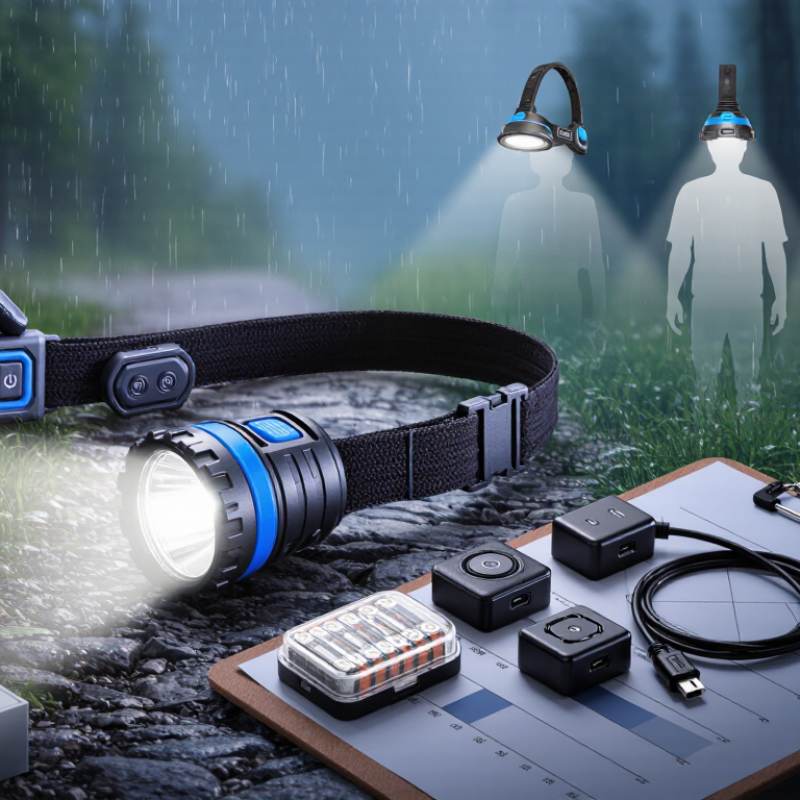
Sourcing a Hot Sale Rechargeable Headlamp requires more than finding a bright product at a low price. Buyers must examine battery capacity, charging stability, beam distance, comfort, and actual field performance. A headlamp may look impressive online, yet fail after rain, cold exposure, or repeated charging.

Dr. Mark S. Rea, a respected lighting researcher, has stated, “Good lighting supports the task without becoming the task.” This principle fits headlamp sourcing well. The beam should illuminate a narrow trail without creating harsh glare. The strap should remain steady during movement. The charging port should feel protected, not loosely covered by thin rubber.

Reliable suppliers can provide test reports, battery specifications, sample units, and consistent production records. Ask for charging-cycle data. Check the switch with wet gloves. Inspect the hinge after repeated adjustment. Small details reveal large quality problems.

Pricing still matters. However, the cheapest offer may hide weaker batteries, inconsistent LEDs, or poor packaging. That is easy to overlook. It is also expensive later.

A practical sourcing process compares at least three suppliers, tests physical samples, and confirms quality standards before placing a large order. Certifications should be verified, not simply printed on a product page. Customer reviews can help, but they may not reveal factory-level consistency.

The market changes quickly. A popular model today may become ordinary next season. Therefore, this guide considers product reliability, user experience, supplier communication, and realistic demand. Some assumptions may prove wrong. Careful testing remains the safer choice.

How to Source Hot Sale Rechargeable Headlamps?

Define the Key Features of a High-Demand Rechargeable Headlamp

How to Source Hot Sale Rechargeable Headlamps?

Define the Key Features of a High-Demand Rechargeable Headlamp

A high-demand rechargeable headlamp starts with dependable illumination, not exaggerated brightness claims. During sample testing, measure beam distance, output stability, and runtime at several brightness levels. A useful model should light a narrow trail without creating harsh glare. Its beam should also cover nearby ground for safer movement.

Battery performance strongly affects repeat purchases. Look for a rechargeable lithium battery with clear capacity information and stable charging protection. USB-C charging is convenient for warehouses, outdoor workers, and household users. Check charging time, standby drain, and performance in cool conditions. Numbers on a specification sheet can be optimistic. Test them independently.

Comfort is equally important. A balanced headlamp should stay secure when users bend, climb, or move quickly. Adjustable straps, a soft forehead pad, and a low-profile body reduce pressure. Water resistance and impact resistance add practical value, but suppliers should provide reliable test documents. Inspect the seals yourself.

I once rejected a bright sample because its hinge loosened after repeated adjustment. That small weakness mattered more than its impressive output. Ask suppliers for production samples, inspection records, battery details, and packaging photos. Confirm consistent color, charging ports, switches, and instruction labels before placing a larger order. A slightly heavier lamp may feel stronger, but some users will find it tiring after several hours. Test it with real users, not only on a factory table.

How to Source Hot Sale Rechargeable Headlamps?

Key features of a high-demand rechargeable headlamp

This indicative 100-point sourcing benchmark prioritizes dependable brightness, long runtime, convenient USB-C charging, water resistance, wearing comfort, and adjustable beam performance. Suppliers should validate these targets through samples, lumen tests, runtime tests, charging-cycle checks, and water-resistance inspection.

Research Target Markets and Identify Profitable Buyer Needs

How to Source Hot Sale Rechargeable Headlamps?

Researching target markets is more useful than chasing popular product lists. Outdoor campers may need long runtime and weather resistance. Trail runners often prefer lightweight designs and stable headbands. Warehouse workers may value wide beams, simple controls, and comfortable charging routines. Compare search trends, customer reviews, seasonal demand, and competitor pricing before contacting suppliers. Look for repeated complaints, such as weak hinges, loose straps, or confusing battery indicators. These details reveal profitable buyer needs more clearly than general market size.

A reliable sourcing process should test samples in realistic conditions. Wear the headlamp during a night walk. Operate the buttons with cold or wet fingers. Check charging time, beam consistency, heat, and battery performance. Ask suppliers for material details, test reports, and clear production tolerances. Confirm whether the stated water resistance matches documented testing. Do not trust polished photos alone. They can hide poor finishing. One useful lesson is that buyers may accept fewer modes when the main beam performs better. I might overvalue extra features sometimes.

Tips: Build separate product briefs for each market. Record target weight, runtime, brightness range, charging type, and retail price. Interview distributors before placing large orders. Request small trial quantities first. Track returns and complaints after launch. A product can sell quickly and still disappoint customers if its battery fades after several uses. Recheck assumptions every season.

Compare Suppliers, Product Quality, and Rechargeable Battery Options

Sourcing hot-sale rechargeable headlamps requires more than checking a low quotation. Compare suppliers by production experience, response speed, sample quality, and quality-control records. Ask for clear specifications, including brightness, beam distance, charging time, waterproof rating, and operating temperature. A reliable supplier should explain test methods instead of offering vague promises. Request samples from several factories and inspect the switches, hinges, charging ports, and head straps. Small defects often appear after repeated use.

Product quality depends on both design and assembly. Test each sample for stable brightness, comfortable weight, heat control, and battery performance. A headlamp that looks bright for five minutes may perform poorly during longer work. Check whether the supplier tests charging safety, over-discharge protection, and battery cycle life. Keep written inspection results. My experience is that attractive samples can hide inconsistent internal parts. Do not trust appearance alone.

Tips: Compare rechargeable battery options carefully. Lithium-ion batteries usually offer strong capacity and compact size, while lithium-polymer versions allow flexible shapes but may need careful protection. Ask about cell capacity, charging cycles, replacement availability, and storage conditions. Confirm that the charger matches the battery system. Test several units from the same shipment, not just one sample. This step takes time, but skipping it can create costly returns and uncertain customer feedback.

How to Source Hot Sale Rechargeable Headlamps? — Compare Suppliers, Product Quality, and Rechargeable Battery Options
Supplier Profile Typical MOQ Typical Lead Time Common Headlamp Configuration LED Output Range Runtime Range Rechargeable Battery Options Charging Interface Key Quality Indicators Relevant Compliance Documents Indicative FOB Range Best Fit
High-volume OEM/ODM manufacturer 1,000–3,000 units 35–60 days ABS or PC housing, adjustable elastic headband, single or dual LED 300–1,000 lm 3–12 hours 3.7 V lithium-ion, usually 1,200–3,000 mAh; protected cell recommended USB-C; some models include charge-level indicators LED bin consistency, waterproof seal testing, switch-cycle testing, battery capacity verification UN 38.3 test summary, IEC 62133-2 test report, CE or UKCA documentation where applicable, RoHS declaration US$4.50–10.00 Private-label launches and repeat retail orders
Specialized outdoor-lighting supplier 500–1,500 units 25–45 days Lightweight PC or nylon body, focused beam, red-light mode, rear battery pack on selected models 200–800 lm 4–20 hours 3.7 V lithium-ion pack; some products support replaceable protected cells USB-C or sealed magnetic charging contact Beam uniformity, impact resistance, thermal management, IPX4–IPX6 water-resistance testing Battery transport documentation, EMC test report, RoHS declaration, ingress-protection test report if claimed US$5.00–13.00 Camping, hiking, running, and outdoor specialty channels
Cost-focused assembly supplier 300–1,000 units 20–40 days Basic ABS housing, single white LED, elastic headband, compact charging circuit 100–400 lm 2–8 hours 3.7 V lithium-ion, commonly 500–1,500 mAh; battery protection should be verified Micro-USB or USB-C depending on the model Actual lumen measurement, charging cut-off test, battery-capacity test, housing inspection UN 38.3 documentation, RoHS declaration, EMC documentation where required US$2.20–5.50 Promotional products, entry-level retail, and price-sensitive projects
Premium performance supplier 300–800 units 30–55 days Aluminum or reinforced PC body, multiple light modes, regulated driver, improved heat dissipation 500–1,500 lm 5–30 hours High-quality 3.7 V lithium-ion pack, commonly 2,000–5,000 mAh; thermal and over-current protection expected USB-C, often with fast-charge support subject to design limits Regulated output, thermal testing, drop testing, switch-cycle testing, accurate runtime testing UN 38.3, IEC 62133-2, EMC report, RoHS declaration, and IP rating test report when advertised US$10.00–24.00 Technical outdoor markets and higher-margin products
Work-light and industrial supplier 500–2,000 units 30–60 days Impact-resistant housing, wide flood beam, helmet clips, high-visibility colors 250–1,000 lm 4–18 hours 3.7 V lithium-ion pack; larger packs may use 7.4 V dual-cell configurations USB-C or protected charging port with rubber cover Drop resistance, chemical resistance, temperature-cycle testing, IPX4–IPX7 verification where claimed UN 38.3, IEC 62133-2, CE or UKCA where applicable, RoHS, EMC, and ingress-protection report US$6.50–16.00 Maintenance, construction, warehousing, and emergency-use applications
Small-batch customization supplier 100–500 units 15–35 days Existing shell with customized color, logo, packaging, or minor accessory changes 150–600 lm 3–15 hours Standard 3.7 V lithium-ion pack selected from approved existing designs USB-C or Micro-USB depending on available platform Incoming battery inspection, sample runtime test, charging safety test, logo and packaging inspection Supplier-provided UN 38.3 documentation, RoHS declaration, and product test records US$3.50–9.00 Market testing, seasonal campaigns, and small e-commerce orders
Sourcing note: The figures above are practical market benchmarks for standard rechargeable headlamp configurations, not quotations from named companies or brands. Before placing an order, confirm measured lumens, regulated runtime, battery capacity, cell protection, charging temperature, IP rating, drop performance, and current battery-transport documentation.
Rechargeable Battery Option Comparison
Battery Option Nominal Voltage Typical Capacity in Headlamps Typical Runtime Potential Main Advantages Main Limitations Recommended Quality Checks Suitable Product Positioning
Protected lithium-ion pouch cell 3.7 V 1,000–3,000 mAh Medium to long, depending on LED output and driver efficiency High energy density, compact shape, flexible housing design Requires protection against over-charge, over-discharge, and short circuit; pouch swelling must be controlled Capacity test, internal-resistance test, protection-board cut-off test, UN 38.3 documentation General-purpose consumer and outdoor headlamps
Protected cylindrical lithium-ion cell 3.6–3.7 V 1,800–3,500 mAh per cell Medium to long; multiple cells can extend runtime Rigid construction, broad availability, good energy density Requires secure cell holders or welded connections; counterfeit or mismatched cells are a sourcing risk Cell identity verification, capacity grading, weld inspection, thermal test, transport test summary Performance-oriented and industrial headlamps
Dual-cell lithium-ion pack 7.2–7.4 V 2,000–5,000 mAh Long runtime for high-output or remote-battery designs Supports higher power levels and longer operating periods Heavier, larger, more expensive, and requires balanced charging and suitable protection circuitry Cell matching, balance-protection test, pack temperature test, charger compatibility, UN 38.3 documentation High-output, work, rescue, and extended-runtime products
Lithium iron phosphate battery 3.2 V per cell 1,000–3,000 mAh Moderate, with strong cycle-life performance Good thermal stability and long cycle life compared with many standard lithium-ion chemistries Lower energy density and lower nominal voltage may require a different LED driver and charging system Correct charger profile, cell balancing where applicable, capacity test, temperature-rise test Durability-focused and frequently rechargeable applications
Nickel-metal hydride rechargeable pack 1.2 V per cell 600–2,500 mAh Moderate; normally requires multiple cells in series Lower fire risk than lithium-based packs and suitable for some legacy designs Heavier and less energy-dense; higher self-discharge and slower charging are common concerns Cell matching, charging-temperature monitoring, leakage inspection, cycle-life test Low-power, legacy, and safety-prioritized designs

Evaluate Samples, Certifications, Pricing, and Minimum Order Terms

How to Source Hot Sale Rechargeable Headlamps?

A reliable sourcing process starts with physical samples, not catalog photos. Request two or three samples with identical specifications. Check beam distance, brightness levels, charging time, switch response, and headband comfort. Test each lamp for several hours. Feel the heat around the charging port. Small details matter. I once approved a sample too quickly and missed a loose battery cover. That mistake later affected packaging and customer reviews.

Ask suppliers for current test reports and certification documents. Verify whether the documents match the exact model, battery, and factory address. Depending on your target market, review electrical safety, battery transport, chemical restriction, and water-resistance requirements. An IP rating should support real test evidence, not only a printed claim. Request the report number and issuing laboratory. Documents can look professional and still be outdated.

Compare pricing by calculating the full landed cost. Include the lamp, spare straps, packaging, inspection, freight, duties, and payment fees. A low unit price may hide expensive customization. Discuss minimum order quantity, sample fees, deposit terms, production time, and replacement policies. Negotiate a smaller trial order when possible. However, a low MOQ may increase packaging costs. Ask for price breaks at several quantities, such as 100, 500, and 1,000 units. Leave room for defects, because perfection is not guaranteed.

Build a Reliable Sourcing Plan for Launch and Long-Term Supply

How to Source Hot Sale Rechargeable Headlamps?

A reliable sourcing plan begins with a clear product brief. Define brightness, beam distance, runtime, weight, charging method, and water resistance. For launch, request samples with different battery capacities and LED settings. Test them in warehouses, on trails, and during power outages. Record charging time, heat, strap comfort, and switch response. Marketing claims must match measured performance. Small differences matter.

Tips: Ask suppliers for battery test reports, material details, and production photos. Check whether the charging port, headband, and lamp housing can handle repeated use. Request a written sample approval process. Do not rely on catalog photos alone. They often hide practical weaknesses.

For long-term supply, compare minimum order quantities, tooling costs, lead times, payment terms, and quality-control procedures. A stable supplier should explain how it manages component shortages. Keep a second qualified source, even if it costs slightly more. Confirm packaging dimensions before shipping; oversized cartons quietly increase freight costs. Review production samples regularly, not only during the first order. This takes time. It prevents surprises.

Use a pre-shipment inspection with measurable standards, such as lumen tolerance, charging performance, battery safety, and switch durability. Confirm applicable safety, labeling, and transport requirements for each sales market. I have seen promising launches slow down because a simple instruction sheet was incomplete. That mistake is avoidable, but not always.

has been added to your cart.
Checkout