What Type of LED Spotlights Are Best?
Choosing the right LED spotlights is not simply a matter of picking the brightest bulb. The best option depends on where the light will be installed, what it must illuminate, and how long it will operate each day. A narrow beam may highlight a painting beautifully, yet create harsh shadows across a kitchen worktop. A wider beam can feel softer, but it may waste light on nearby walls.
Real-world experience matters here. A spotlight rated at 1,000 lumens can appear surprisingly weak in a large room with dark surfaces. White ceilings and pale walls reflect light more effectively. Beam angle, color temperature, dimming compatibility, and heat management also influence daily performance. Warm white light often suits bedrooms and restaurants, while neutral white can improve visibility in kitchens, offices, and workshops.
Small details matter.
Quality specifications should come from reliable manufacturers, independent testing, and clear warranty information. Look for accurate color rendering, stable drivers, suitable ingress protection, and energy efficiency. However, no single product is perfect. A highly efficient model may have limited dimming performance, while a compact design may run warmer than expected. I have found that installation height and surface color can change the result more than product photos suggest.
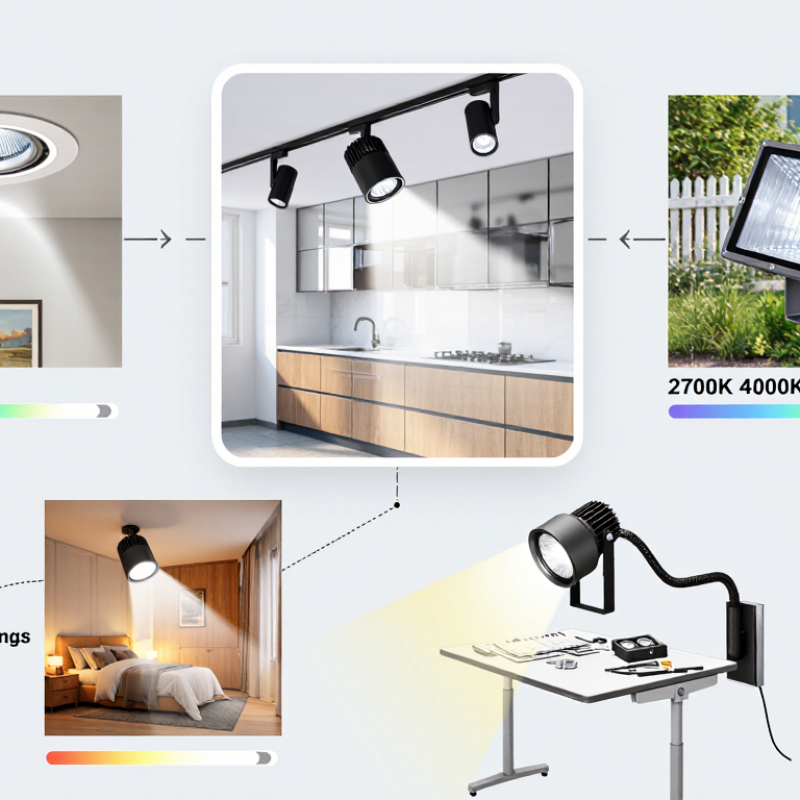
This guide examines different types of LED spotlights, including recessed, track-mounted, outdoor, and adjustable models. It compares their practical strengths, limitations, and ideal applications. The goal is not to promote the most expensive choice. It is to help you select dependable lighting that feels right in the actual space.
LED Spotlight Types: COB, SMD, and Chip-on-Board Performance Compared
What Type of LED Spotlights Are Best?
COB and Chip-on-Board describe the same LED technology, not two separate types. COB places many LED chips on one compact substrate. This creates a dense, bright light source with a smooth appearance. In practical installations, COB spotlights often produce strong center brightness and clean beams. They suit retail displays, kitchens, and accent lighting. However, their concentrated output can create glare without a quality lens or proper aiming.
SMD LEDs mount individual diodes onto a circuit board. This structure allows more flexible layouts, beam patterns, and color options. SMD spotlights may spread light more evenly across wider areas. They can also support easier module design and efficient heat distribution. Yet, performance depends heavily on the driver, board quality, and thermal path. A cheaper SMD unit may still show uneven color or visible flicker. Brightness alone is not enough.
Tips: Check the beam angle, color temperature, CRI, flicker performance, and heat sink size. For a small display, I often prefer COB’s focused beam. For general room lighting, SMD can feel softer. That is not universal. A poorly cooled COB may lose brightness quickly, while an SMD spotlight with weak optics can look flat. Test the light at its actual mounting height before choosing.
What Type of LED Spotlights Are Best?
LED Spotlight Types: COB, SMD, and Chip-on-Board Performance Compared
COB means “Chip-on-Board,” so these terms describe the same LED packaging approach. The chart compares representative typical luminous-efficacy values for spotlight applications; actual performance varies with LED current, optics, color temperature, and thermal design.
Choosing Beam Angles: Narrow 10°–25° Versus Wide 36°–60° Distributions
Choosing an LED spotlight begins with the beam angle, not wattage alone. A narrow 10°–25° beam concentrates light into a bright, defined pool. It suits artwork, shelves, tall trees, and architectural details needing visual emphasis. On a high ceiling, it can reach the target without spreading excessive light across nearby surfaces. However, narrow optics magnify aiming errors. A small tilt can move the highlight noticeably.
Wider 36°–60° distributions create softer coverage across tables, corridors, retail areas, and living rooms. They reduce harsh contrast and often need fewer fixtures for general illumination. At a low ceiling, a wide beam usually feels more comfortable. It can still look flat when used everywhere. That is the compromise.
I recommend testing both angles at the actual mounting height, using a temporary fixture and a white surface. Check the center brightness, edge falloff, shadows, and glare from seated eye level. For a gallery wall, 15° may sharpen texture; for a dining table, 40° often spreads light more naturally. These are starting points, not rules. Room color, surface reflectance, and fixture spacing change the result. It depends. I once favored a narrow beam for dramatic contrast, then noticed visitors squinting. The scene looked impressive, but it was not comfortable. Reliable selection requires measuring and observing, not trusting beam labels alone.
Evaluating Brightness Through Lumens, Efficacy, and 80–150 lm/W Ratings
What type of LED spotlights are best? For most applications, the useful starting point is brightness measured in lumens, not watts. Lumens indicate the total visible light produced by a spotlight. A 1,000-lumen fixture can illuminate a workbench effectively. However, total output does not tell the whole story. Beam angle matters too. A narrow beam creates a stronger pool of light, while a wide beam spreads brightness across a larger area.
Efficacy, measured in lumens per watt (lm/W), shows how efficiently a spotlight converts electricity into light. An 80–150 lm/W rating is generally a practical range for efficient LED lighting. At 100 lm/W, producing 1,000 lumens requires approximately 10 watts. Still, published ratings may describe laboratory conditions. Heat, the driver, housing, and optical losses can reduce real-world performance. The number looked impressive. The room stayed dim.
When comparing models, check delivered lumens, not only the LED chip’s rated output. For a kitchen counter, choose enough focused light to avoid shadows on the cutting surface. For a garden path, a wider beam may provide safer, more even coverage. I once selected a high-lumen spotlight with a very tight beam. The center was bright, but the surrounding area disappeared. Check operating temperature, rated lifespan, color rendering, and test conditions before buying. A small difference in beam design can matter more than another 200 lumens.
Selecting Color Quality: CRI 80+, CRI 90+, and 2,700–6,500 K CCT
For LED spotlights, color quality matters as much as brightness. CRI 80+ is a practical baseline for hallways, garages, and general task lighting. However, CRI measures only selected color samples. The IES TM-30-20 method adds fidelity (Rf) and gamut (Rg), giving a clearer view of reds, skin tones, and saturated objects. A spotlight with CRI 90+ usually renders artwork, food, and fabrics more naturally. It may also cost more and produce slightly fewer lumens.
CCT controls the visual mood. The 2,700–3,000 K range creates warm, candlelike light for bedrooms and hospitality areas. Around 3,500–4,000 K feels cleaner in kitchens, offices, and workshops. The 5,000–6,500 K range appears cool and daylight-like, but it can feel harsh indoors. CIE 015:2018 defines correlated color temperature, yet CCT alone cannot predict color accuracy. Two 4,000 K spotlights may look noticeably different.
I have seen 6,000 K lamps make white walls look blue. That result was technically expected, but visually disappointing. The U.S. Department of Energy’s Solid-State Lighting reports emphasize testing consistency, thermal management, and color stability. Check the LM-80 data, TM-21 projection, and measured CRI before purchasing. ENERGY STAR lamp specifications commonly set CRI at 80 or higher, while premium visual applications often justify CRI 90+. Still, higher CRI is not automatically better. Beam angle, dimming behavior, glare, and actual room surfaces deserve equal attention.
Assessing Lifespan, Heat Management, and 25,000–50,000-Hour Ratings
What type of LED spotlights are best depends on the installation, not only the advertised wattage. A useful starting point is the lifespan rating. A 25,000-hour rating can provide about 8.5 years at eight hours daily. A 50,000-hour rating may reach roughly 17 years under the same schedule. However, these figures usually describe the time until light output falls to a defined level, often L70. They do not guarantee perfect brightness for every year.
Heat management strongly affects real performance. An aluminum housing can help transfer heat away from the LED, while open ventilation prevents heat from collecting around the fitting. Recessed spotlights need extra care because insulation, dust, or a tight ceiling cavity can trap warmth. Excessive heat may reduce brightness, shorten component life, and cause premature flickering. In practical inspections, the hottest area is often near the driver, not the visible lens. The rating may look impressive, but installation conditions can quietly reduce it.
Tips: Check the operating temperature range, driver quality, dimming compatibility, and replacement access. Look for testing details behind the 25,000–50,000-hour claim. A longer rating is not always better if heat control is weak. I would rather choose a moderately rated spotlight with clear thermal data than trust a large number alone. Even careful selection can miss real-world airflow problems.